The Emerald Tree Boa: The Bright Green Hunter of the Rainforest Canopy
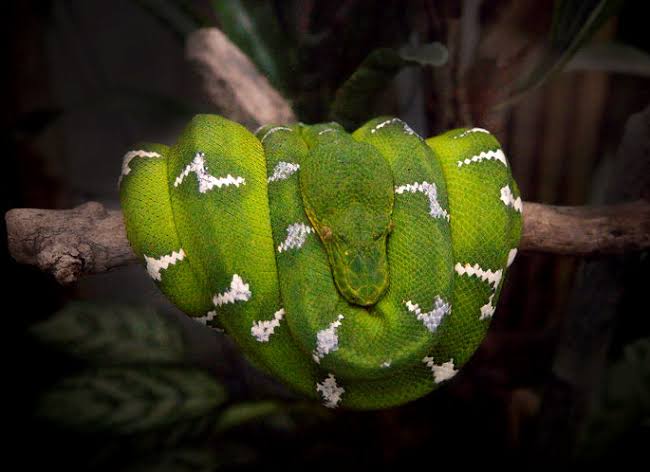
Meet the emerald tree boa, a non-venomous snake that spends almost its whole life coiled in the South American rainforest canopy.
Look up into the tangled branches of a South American rainforest and you might spot what looks like a green ribbon folded over a limb. That's the emerald tree boa (Corallus caninus), a non-venomous constrictor that lives almost its entire life high in the canopy. While heavier snakes hunt along the muddy forest floor, this one stays up in the trees, hidden by its colour and holding on tight while it waits for a meal to come past.
Built for life in the trees
Colour that disappears into the leaves
Adults are a bright, glossy green with uneven white or pale yellow markings running across the back, a bit like small lightning bolts. In dappled sunlight those markings break up the snake's outline, so it blends straight into the foliage around it.
Long front teeth
For a snake its size, the emerald tree boa has unusually long, curved front teeth, among the largest of any non-venomous snake. They work like hooks, getting through thick feathers and fur so a bird or small mammal can't slip free while the snake is hanging in mid-air.
Heat-sensing pits
Along its upper and lower lips sit rows of deep pits that pick up tiny changes in temperature. They let the boa sense the body heat of warm-blooded animals nearby, so it can hunt just as well in complete darkness as it can by day.
A tail that holds on
Its strong, gripping tail wraps firmly around a branch and acts like a safety line. With the back half anchored, the snake can drop its head and front body down to strike at prey passing underneath.
A few things you might not expect
The babies aren't green
Young emerald tree boas are born brick red, orange or yellow. Those colours help them hide among dead leaves and lower shrubs where they spend their early months. As they grow and move higher into the trees, they gradually turn green, usually within their first year.
They sleep in tidy coils
At rest, an emerald tree boa loops itself neatly over a horizontal branch in even coils, with its head tucked in the middle. From below it looks almost like a saddle, and it's one of the easiest ways to recognise the species.
One meal lasts a long time
Hanging in the trees while digesting a big meal takes a lot of energy, so these boas have a slow metabolism. A single good-sized bird or small mammal can keep an adult going for several weeks before it needs to hunt again.
Why the canopy matters
The emerald tree boa depends on tall, unbroken forest. Every branch it rests on and every animal it hunts is part of the same canopy. Protecting rainforest keeps that whole world above our heads intact, from the smallest tree frog to the green hunter waiting quietly on the branch.